10 TED-Ed Lessons to inspire your New Year’s resolutions
By Emilie Soffe on January 7, 2015 in TED-Ed Lessons
With the exhilarating (and exhausting) holiday season behind us, January offers a month of new beginnings and boundless optimism. In the first few weeks of the new year, millions of people around the world will set pen to paper and hammer out a list of goals for the year ahead. If you haven’t made your New Year’s resolutions yet, check out this collection of TED-Ed Lessons for a little inspiration. Whether you’re hoping to cut down on sweets, improve your writing skills or brush up on some advanced quantum mechanics, we’ve got you covered.
1. CUT DOWN ON THE SWEETS.
The holiday season is perhaps the most sugar-loaded season of them all, but you might consider cutting down the sugary snacking in the new year. When you eat something loaded with sugar, your taste buds, your gut and your brain all take notice. This activation of your reward system is not unlike how bodies process addictive substances such as alcohol or nicotine — an overload of sugar spikes dopamine levels and leaves you craving more. Nicole Avena explains why sweets and treats should be enjoyed in moderation.
2. LEARN TO PLAY A MUSICAL INSTRUMENT.
While learning to play a musical instrument might not immediately propel you to rockstar status, the impact it can have on you is exceptional. So, how do you pick which instrument you should take up? In this installment of the Think Like A Musician series, professional musicians offer insights into how they chose the instrument that was right for them, and what you can consider when choosing what to play.
3. GET MORE SLEEP.
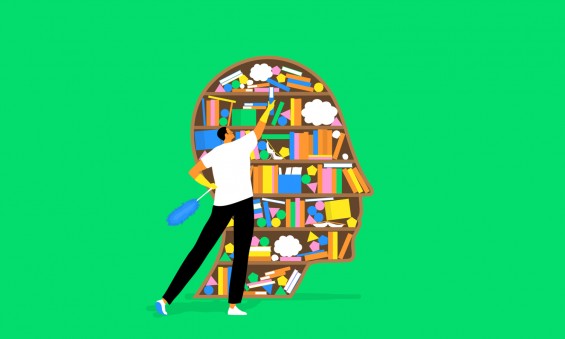
A classic, but very important resolution for anyone with a pulse. When you’re up late studying for tomorrow’s exam, should you drink another cup of coffee and spend the next few hours cramming? Or should you go to sleep? Anna Rothschild explores how a sleepless night impacts your cognitive function, showing how sleep restructures your brain in a way that’s crucial for how our memory works.
4. IMPROVE YOUR WRITING.
One of the most consequential choices in writing is picking a perspective. Told from a different point of view, a story can transform completely. Third person, first person, and second person each have unique possibilities and constraints. So how do you know which is right for your story? Rebekah Bergman breaks down some tips on focusing a story.
5. BUFF UP YOUR KNOWLEDGE OF QUANTUM MECHANICS.
If you’re feeling bold in the new year, why not aim your intellectual sights high and study up on some complex physics? Chad Orzel’s four-part series is a great place to start, with lessons on the central mystery in quantum mechanics, the Heisenberg Uncertainty Principle, and Schrödinger’s cat.
6. LEARN A NEW LANGUAGE.
Over the course of human history, thousands of languages have developed from what was once a much smaller number. One of the oldest known languages is Chinese, dating back over 3,000 years. Gina Marie Elia traces that ancient history, explaining a writing system that is at times both simple and complex, and shares how to identify and write these characters on your own.
7. GET BETTER AT PUBLIC SPEAKING.
If you start labored breathing just thinking about getting onstage, don’t worry — you’re not alone. But the better you prepare for such occasions, the more likely you are to overcome it. The Public Speaking 101 course guides you in how to identify, develop, and share your ideas, while teaching essential communication and presentation skills along the way.
8. TAKE MORE TRIPS TO THE ART MUSEUM.
Art is important, even if you’re not an artist. Many professionals (including doctors, nurses and police officers) can learn real world skills through art analysis. Studying art like René Magritte’s Time Transfixed can enhance communication and analytical skills, with an emphasis on both the seen and unseen. Amy E. Herman explains why art historical training can prepare you for real world investigation in 2015.
9. BE KIND TO THE ENVIRONMENT.
What if the future was awesome? Faced with the realities of current crises, it’s easy to assume our world is headed in a bleak direction. But there’s good reason to be hopeful — with developments in science and technology, a positive future is more viable than ever before. Iseult Gillespie takes a look at what three cities could look like in 2125 if we start changing now.
10. SHARPEN YOUR NETWORKING SKILLS.
Networking seems so hard — but not if you have the right advice. Try taking advantage of weak ties; you never know how a friend of a friend of a friend can aid you in your dreams. Lisa Green Chau outlines how being proactive and always saying yes can lead to future opportunities.

I really liked this post, and I love this initiative of “TED Ed”. Thank you all for the hard work.
Va yaar
Thank you Ted Ed for a very sensible posts! Keep it up.
The writing style is so intriguing! I will definitely go through these videos. Thank you guys so much for your recommendation!