The 10 most popular TED-Ed Animations of 2025
By Lauren McAlpine on December 15, 2025 in News + Updates
Xixi Wang
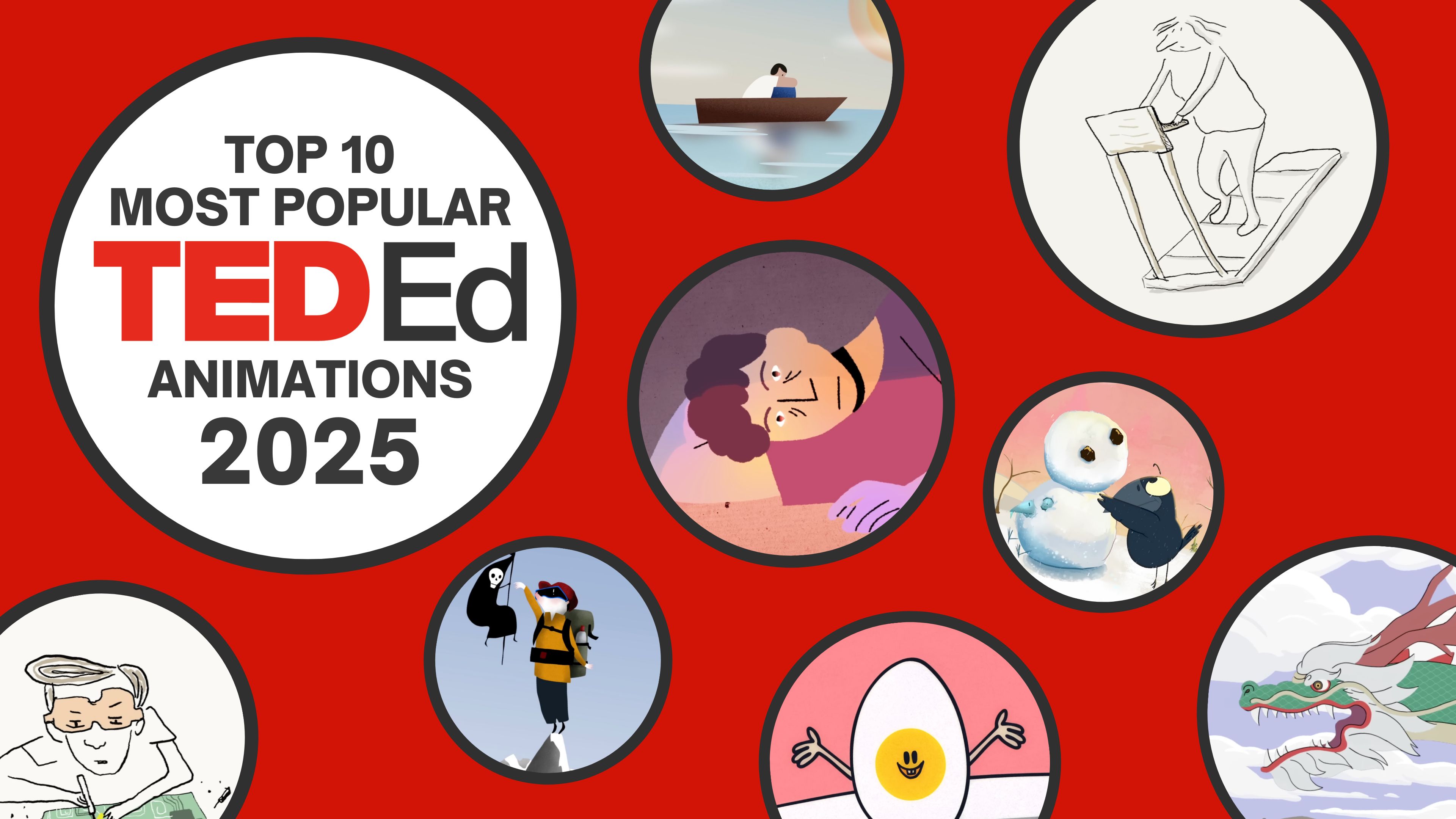
In 2025, our YouTube audience spent nearly 16 million hours watching TED-Ed Animations (that’s equal to over 1,800 years!). Our most-viewed videos of 2025 include an exploration of dragon legends from around the world, tips on how to best build new skills, an explanation of why it’s a really bad idea to mess with a crow, a handful to help you understand your body, and more!
Behold our top 10 most popular videos of 2025:
1. Do you really need to take 10,000 steps a day?
For years, Jean Béliveau walked from country to country, with the goal of circumnavigating the globe on foot. While few people have the time or desire to walk such extreme lengths, research shows that adding even a modest amount of walking to your daily routine can dramatically improve your health. So, what exactly happens to your body when you increase your step count? Shannon Odell investigates.
2. What happens to your brain without any social contact?
Everyone needs time to themselves, and peaceful solitude has stress-relieving benefits. But when being alone is forced upon you, the effects can be surprisingly extensive. And though different people experience distinct effects, symptoms tend to become more severe and persistent the longer one’s isolated. So, how exactly does isolation affect your body and brain? Terry Kupers investigates.
3. Why do so many cultures have dragon legends?
From the Chinese Loong to the Filipino Bakunawa, the Scottish Beithir and the Greek Hydra, dragons have inflamed imaginations for millennia. Their ubiquity across world mythology has led many scholars to ponder their possible origins. Could it be that tales of dragons were crafted to make sense of violent weather events? Timothy J. Burbery shares what geomythology has uncovered about dragons.
4. If you had the chance to be immortal, would you take it?
While cleaning out your uncle’s attic you find a chest with a sparkling potion. The attached tag declares drinking this liquid will make you immortal. Your body will be frozen at its current age, and these effects would be final and irreversible. The instructions are clear — the only question is, do you drink the potion? Sarah Stroud and Michael Vazquez explore this philosophical debate.
5. Can you “see” images in your mind? Some people can’t
When reading “Alice’s Adventures in Wonderland,” most readers visualize the queen’s croquet game play out in their heads. A few might see the scene in vivid detail. However, a small fraction of readers have a drastically different experience: within their heads, they “see” absolutely nothing. Why do some people have an inability to visualize images? Adam Zeman explores the science of aphantasia.
6. What actually causes high cholesterol?
In 1968, the American Heart Association made an announcement that would influence people’s diets for decades: they recommended that people avoid eating more than three eggs a week. Their reasoning was that the cholesterol packed into egg yolks could increase cardiovascular disease risk. So, what exactly is cholesterol? And is it actually bad for you? Hei Man Chan digs into this complex molecule.
7. The best way to become good at something might surprise you
There’s a common idea that it takes 10,000 hours of practice to become great at something. From an early age, we are encouraged to choose our path, focus specifically, and start racking up those hours. But, what if these head starts aren’t helping us the way we think they do? What if there’s a better way to excel? David Epstein shares how a different approach could set us up for greater success.
8. What’s the best way to lift people out of poverty?
In 2018, a nonprofit gave every adult in the Ahenyo village $500. Most families had lived in extreme poverty for generations, and this sum was roughly equivalent to their annual salaries. The money came with no strings attached to how it could be spent. Would this lift villagers out of poverty or be another failed philanthropic endeavor? Explore aid programs and how they address people’s needs.
9. How smart are crows?
In one of Aesop’s fables, a crow is searching for water. It spies a pitcher— but the water inside is beyond its reach. So, the crow begins dropping in pebbles. One-by-one, they displace the water, and the crow quenches its thirst. This is just one of many fascinating displays of intelligence from corvids. Katharina Brecht digs into what makes this bold, brainy family of songbirds so smart.
10. Why don’t we get our drinking water from the ocean?
Humans have been transforming seawater into potable freshwater for millennia. Today, billions of people can’t access clean drinking water, and 87 different countries are projected to be “water-scarce” by 2050. So, how can we use seawater desalination to combat water scarcity? And can we do it without further harming the environment? Manish Kumar digs into how scientists are creating freshwater.
Tags: Animation, TED-Ed Lessons